Spotlight Archive

On October 11, Pope Benedict XVI canonized Hawaiian missionary Father Damien de Veuster. The saint of Molokai is the most famous representative of a sometimes overlooked Catholic immigrant group: Belgian Americans.
 The predominantly Catholic character of modern-day Belgium is a function of the religious history of the low countries. Emerging out of the turmoil of the sixteenth century, the various regions of The Netherlands and Belgium were divided largely along religious lines. Flemish speaking Catholics joined French-speaking Walloons to the south to form what is now the independent nation of Belgium in 1830. From the sixteenth century on, Belgian explorers, missionaries, and colonists, probed the new worlds of America, Africa, and Asia.
Not all Belgians were Catholic, and Huguenot Flemings were among the Netherlanders who helped to settle Manhattan Island in the seventeenth century. Lord Baltimore, who furnished Catholic colonists with their first home in British North America (Maryland), was of a noble Fleming family.
The peak period of Belgian immigration was 1820–1910, during which time more than 100,000 entered the United States. They were attracted predominantly to the Great Lakes region, but groups of Flemings and Walloons could also be found in Oregon, Kentucky, and West Virginia.
Belgian priests did important missionary work in the United States. Jesuit Louis Hennepin explored and ministered around Lake Superior and the St. Lawrence Valley in the eighteenth century. During the time of the French Revolution, Belgium was under the rule of France, and the resulting persecution of Catholics forced theologian Chalres Nerinckx into exile. He arrived in Kentucky in 1805, and founded the Sisters of Loretto seven years later.
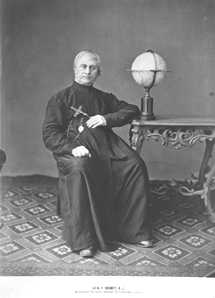 Nerinckx had a further legacy: he recruited Belgian Jesuits to serve the American West, and one of those persuaded to join the New World mission was Pierre de Smet. De Smet was a pioneer missionary in much of the West, working among the Indian tribes of Washington, Idaho, and the Dakotas. Another Nerinckx recruit was James Van den Velde, who became bishop of Chicago in 1849 and of Natchez, Mississippi in 1853. A second Belgium-born bishop was Augustine Van de Vyver, appointed to the see of Richmond, Virginia in 1889.
Detroit was one center of Belgian settlement. In 1834, Father Florimond Bonduel was the first priest to be ordained there; the Belgium-born Jesuit later served as a missionary in what would become the Diocese of Green Bay. In Detroit, Belgian-Americans worshiped with other Catholics at St. Anne's Church and elsewhere until 1884, when their first ethnic parish, Our Lady of Sorrows, was established
In 1853, a missionary, Father Edward Daems, with a group of Belgian immigrants, established a community in northeast Wisconsin called Bay Settlement. Encouraged by the friendly environment created by Fr. Daems, fifteen thousand Belgian-Americans settled the area.
A Belgian congregation of women religious, the Sisters of Notre Dame de Namur, played a major role in education. Sister Louis de Gonzague led a band of eight sisters from Antwerp, arriving in Cincinnati in 1840. They founded Notre Dame Academy there and went on to establish schools in Boston and many other cities. Fr. De Smet requested assistance from them for his post in Oregon in 1844. In 1900, the Notre Dame de Namur sisters entered the higher education field, founding Trinity College in Washington, DC.
 Another tie between the Church in the US and Belgium was created when the American bishops decided on Louvain for the location of a seminary to train American men in European methods and to train Europeans for American service. The American College of Louvain opened in 1857.
Fr. Damien de Veuster came to Hawaii in 1864. He worked among the lepers of Molokai until his death in 1889. The Church’s recognition of his heroic virtue is also a tribute to the contributions made by Belgium to the history of the American Church.
©2009 CatholicHistory.net. Posted October 22, 2009.
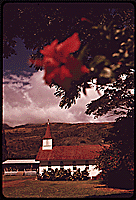
Photos, from top: Antwerp Cathedral, FreeDigitalPhotos.net; Fr. Pierre de Smet, courtesy of Washington State University; Our Lady of Sorrow Church, Molokai; constructed by St. Damien, 1874, courtesy of National Archives and Records Administration (unrestricted).
Sources and Further Reading
Louanna Orth, SNDdeN., “Sisters of Notre Dame de Namur,” The Encyclopedia of American Catholic History
L.W. Tentler, Seasons of Grace: A History of the Catholic Archdiocese of Detroit
