Spotlight Archive

With Samuel Alito's confirmation as Associate Justice of the Supreme Court, he becomes the eleventh Catholic to serve on the body.
The history of Catholics on the nation's highest bench is a mixed one: distinction, mediocrity, and dishonor all can be found.
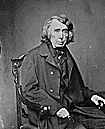 The first Catholic justice was also the first Catholic Chief Justice, Roger Brooke Taney, nominated by President Andrew Jackson in 1836. Taney had a long and successful tenure on the court, distinguished by major decisions in the areas of banking and contract law. But he is most often remembered for leading the court in one of its most infamous decisions, Dred Scott v. Sanford (1857).
After Taney's death in 1864, there was no Catholic on the court until Edward Douglass White was appointed by Benjamin Harrison thirty years later. White became the second Catholic Chief Justice in 1910, and served until his death in 1921. Meanwhile, another Catholic had joined the court, Joseph McKenna, in 1898. Both were overshadowed by two famous contemporary Associate Justices, Oliver Wendell Holmes, Jr., and Louis Brandeis.
McKenna retired in January of 1925. Pierce Butler, nominated by Warren Harding in 1923, was therefore the only Catholic on the court when it rendered its decision in June of that year in the case of Pierce v. Society of Sisters. The Supreme Court upheld a lower court's decision overturning an Oregon law that effectively outlawed Catholic schools.
Butler joined other conservatives in opposing many pieces of President Franklin Roosevelt's New Deal. Of very different background and jurisprudential leanings was the man who replaced him—Frank Murphy, a former Democratic mayor of Detroit and governor of Michigan, appointed by Roosevelt in 1940.
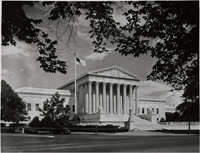 Sherman Minton of Indiana was on the court briefly, from 1949 to 1956, and William J. Brennan, Jr., served a much longer term: thirty-four years from his appointment by Dwight Eisenhower in 1956. Like Taney, Brennan participated in the most contentious and far-reaching decision of his time, Roe v. Wade (1973), which found that a constitutional right to privacy negated state laws prohibiting abortion. Like Taney, too, Brennan sided with the majority, a move that put him at odds with the teaching of his Church.
Toward the end of the twentieth century, three Catholics were appointed in quick succession and remain on the present court: Antonin Scalia in 1986, Anthony Kennedy in 1988, and Clarence Thomas in 1991. When John Roberts was confirmed in October, 2005, he became the tenth Roman Catholic to serve on the Supreme Court, and the third to rank as Chief Justice.
Photos courtesy of National Archives and Records Administration (public domain)
Posted November 2005. Modified (correction) May 2008.